
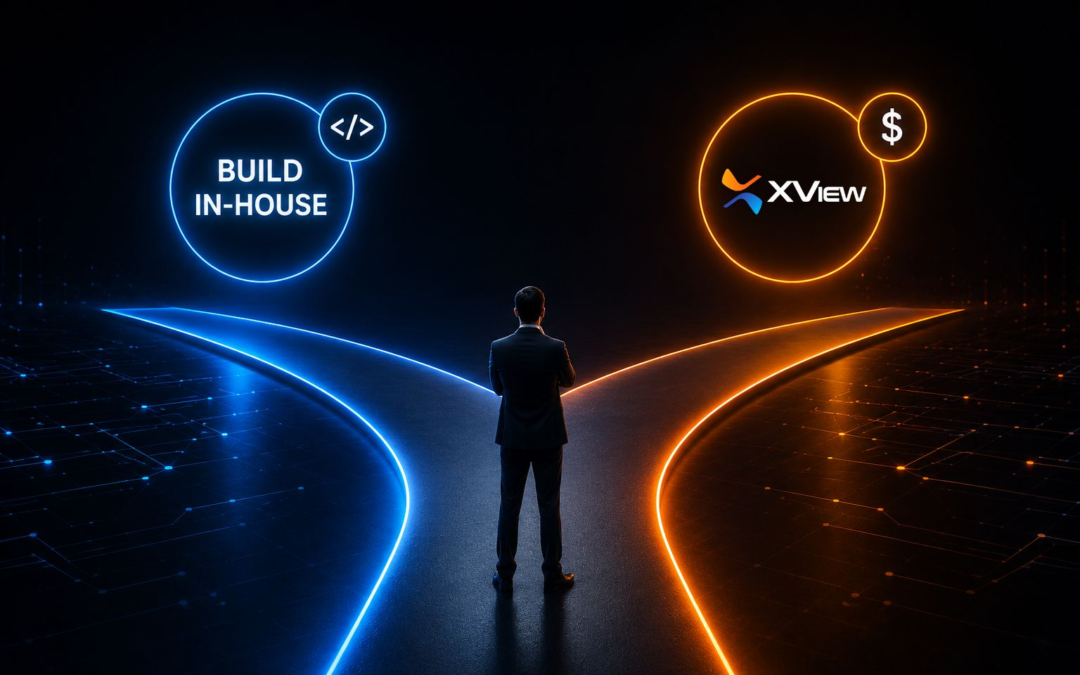
Every golf tech company hits the same fork in the road eventually. You want motion tracking in your product. Maybe it's a swing analyzer, a coaching app, a smart mirror for your facility. And someone on the team says the same thing every time: how hard can it be to build this ourselves?
The honest answer is harder than it looks, and more expensive than it looks. Here's the math nobody runs until they're six months deep.
What building in-house actually costs
Markerless motion capture is not a weekend project. You need computer vision engineers who understand pose estimation, not just general ML folks. You need a dataset of golf swings large enough to train a model that works across body types, swing styles, lighting conditions, and camera angles. You need to validate that data against real biomechanics, because a model that looks accurate and one that is accurate are very different products.
Then you need to maintain it. Golf swings are deceptively hard to track because the motion is fast, the club is thin and easy to lose in frame, and small errors compound into bad advice. A model that's 90 percent accurate sounds fine until you realize the 10 percent is the difference between a coach trusting your product and a coach never opening it again.
Put a number on all that. Engineering salaries, data collection, iteration cycles, ongoing model upkeep. Most teams land somewhere between 12 and 24 months before they have something production ready, and that's assuming the build goes smoothly.
What licensing actually buys you

Licensing an existing SDK flips the timeline. Instead of building the tracking layer from scratch, you're integrating something that already works, already handles the edge cases, and already has real swings behind it. That 12 to 24 month build compresses into weeks.
This is also where the mission mismatch shows up. If your company's value is coaching software, or hardware for driving ranges, or a mobile app experience, then motion capture is not your product. It's infrastructure underneath your product. Every hour your engineers spend chasing pose estimation accuracy is an hour they're not spending on the thing your customers actually pay for.
The real question to ask
Before greenlighting an in-house build, the question worth asking isn't "can we build this." Most technical teams can build almost anything given enough time and money. The real question is whether motion tracking is your core differentiator or just something you need to work reliably in the background.
If it's the former, build away. If it's the latter, you're better off licensing proven tech and putting your engineering budget toward whatever actually makes your product different.

Bottom Line
Build versus buy always comes down to the same tradeoff. Building gives you full control and a long runway before you see results. Licensing gets you to market fast with tech that's already been tested against real swings, real partners, and real facilities.
XView AI's SDK and API were built for exactly this decision point. Sensor-free, markerless tracking already validated internationally, ready to plug into your product instead of spending two years building your own from scratch.
Learn more about the XView SDK
You can also see the consumer side of this same technology in action. Download XView AI free on the App Store.
XView AI is developed by IdeasLab, an AI company building markerless motion capture technology for sports, fitness, and healthcare.